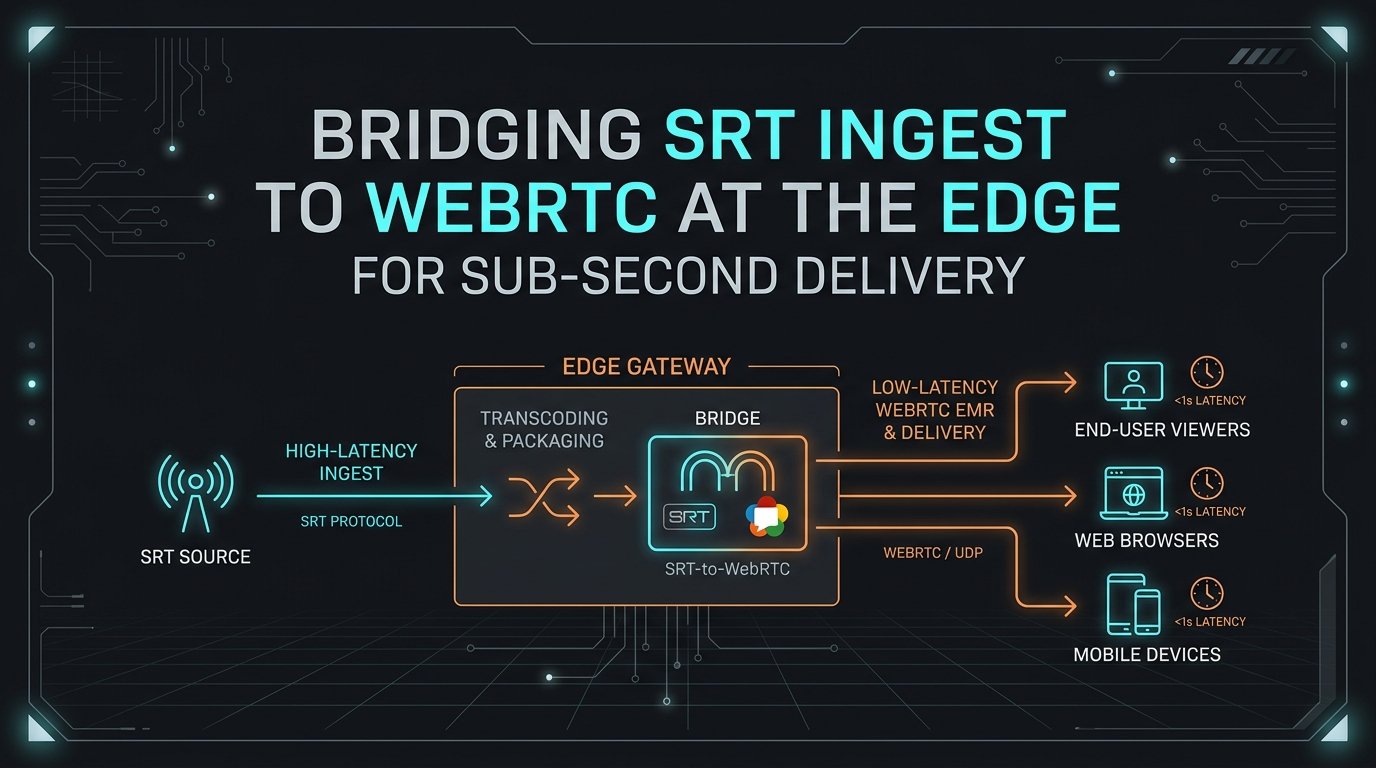
Bridging SRT Ingest to WebRTC at the Edge for Sub-Second Delivery
In modern live production pipelines, achieving sub-second glass-to-glass latency requires a careful balance between contribution and distribution protocols. Secure Reliable Transport (SRT) has emerged as the de facto standard for contribution, offering robust packet recovery and low latency over unpredictable public networks. However, delivering this SRT stream directly to thousands of concurrent end-users remains a challenge, as browsers do not natively support SRT. This is where edge-assisted protocol bridging to WebRTC becomes critical.
Architecting this bridge requires deploying high-performance transcoding and repackaging nodes at the network edge. When an SRT ingest stream arrives at the edge, the container must be demuxed, and the H.264/H.265 video and AAC/Opus audio payloads must be extracted. If transcoding is required—for instance, converting AAC to Opus to meet WebRTC specifications—it must occur instantly using hardware acceleration (such as NVIDIA NVENC or QuickSync) to prevent latency inflation.
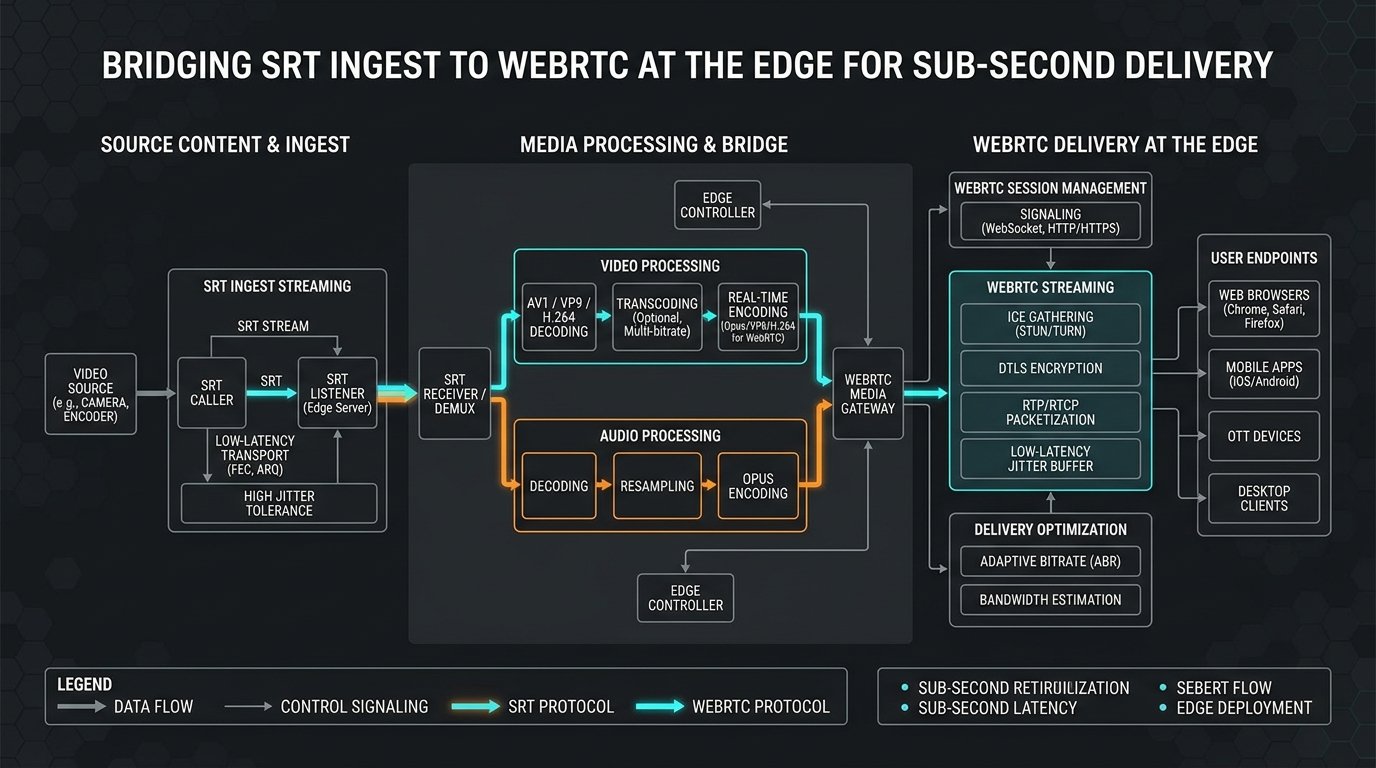
Once the streams are aligned, the edge node repackages the media into RTP packets, establishes DTLS/SRTP sessions with the viewer clients, and initiates WebRTC playback. By performing this translation at edge servers physically close to the end-users, architects minimize the round-trip time (RTT) for WebRTC's NACK-based retransmissions. This distributed architecture not only ensures broadcast-level stability but also maintains an end-to-end latency budget of under 500 milliseconds, paving the way for truly interactive live experiences.