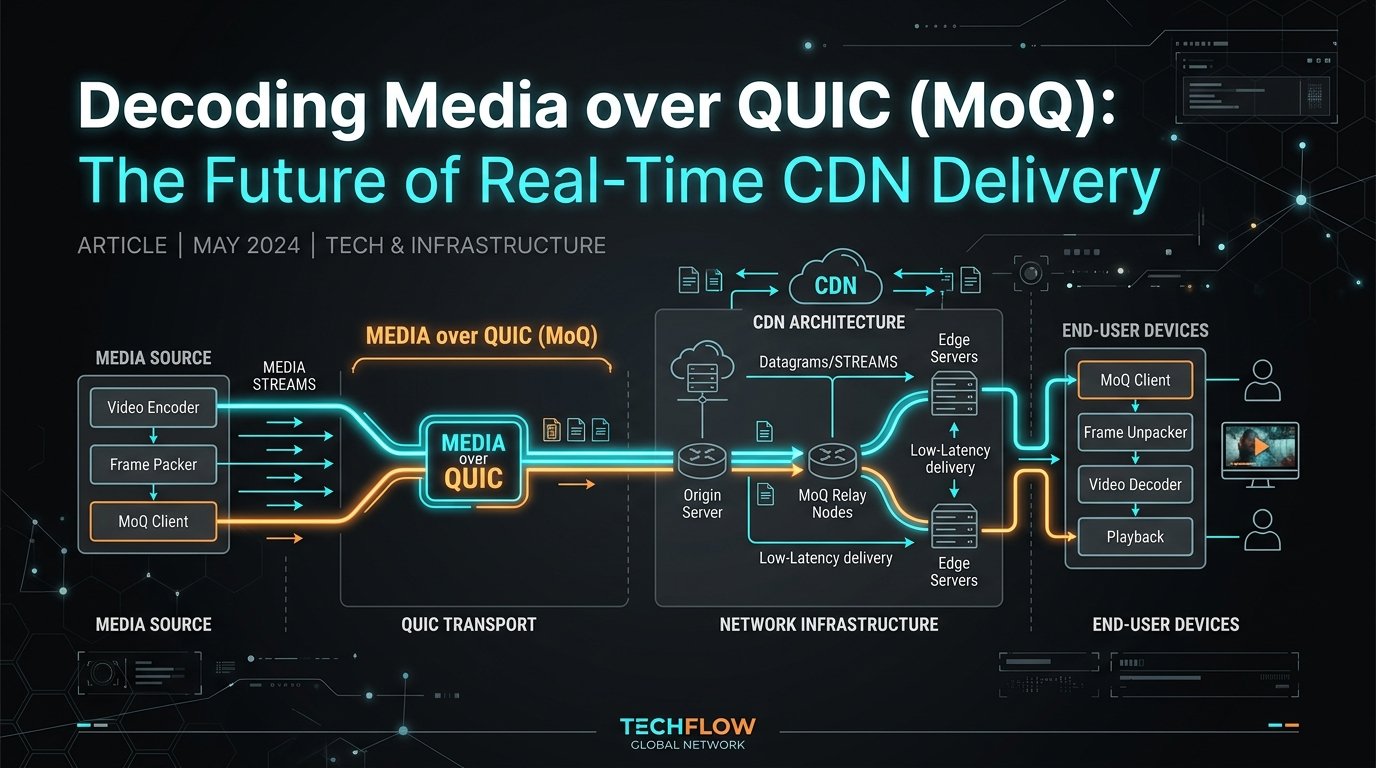
Decoding Media over QUIC (MoQ): The Future of Real-Time CDN Delivery
The landscape of live video streaming is undergoing a seismic shift with the emergence of Media over QUIC (MoQ). Traditionally, architects had to choose between the ultra-low latency of WebRTC (which struggles with CDN-scale distribution due to stateful connection requirements) and the massive scalability of chunk-based HTTP protocols like LL-HLS or LL-DASH, which introduce unavoidable latency overhead. MoQ bridges this gap by utilizing the QUIC transport protocol to deliver media frames with sub-second latency while preserving caching capabilities at the edge.
By leveraging QUIC’s native multiplexing and congestion control mechanisms, MoQ avoids head-of-line blocking—a persistent bottleneck in TCP-based streaming. Furthermore, it operates on a publish-subscribe model, where media is split into tracks, groups, and objects. This object-oriented approach allows edge nodes to cache and prioritize data packets intelligently based on network conditions and playback requirements.
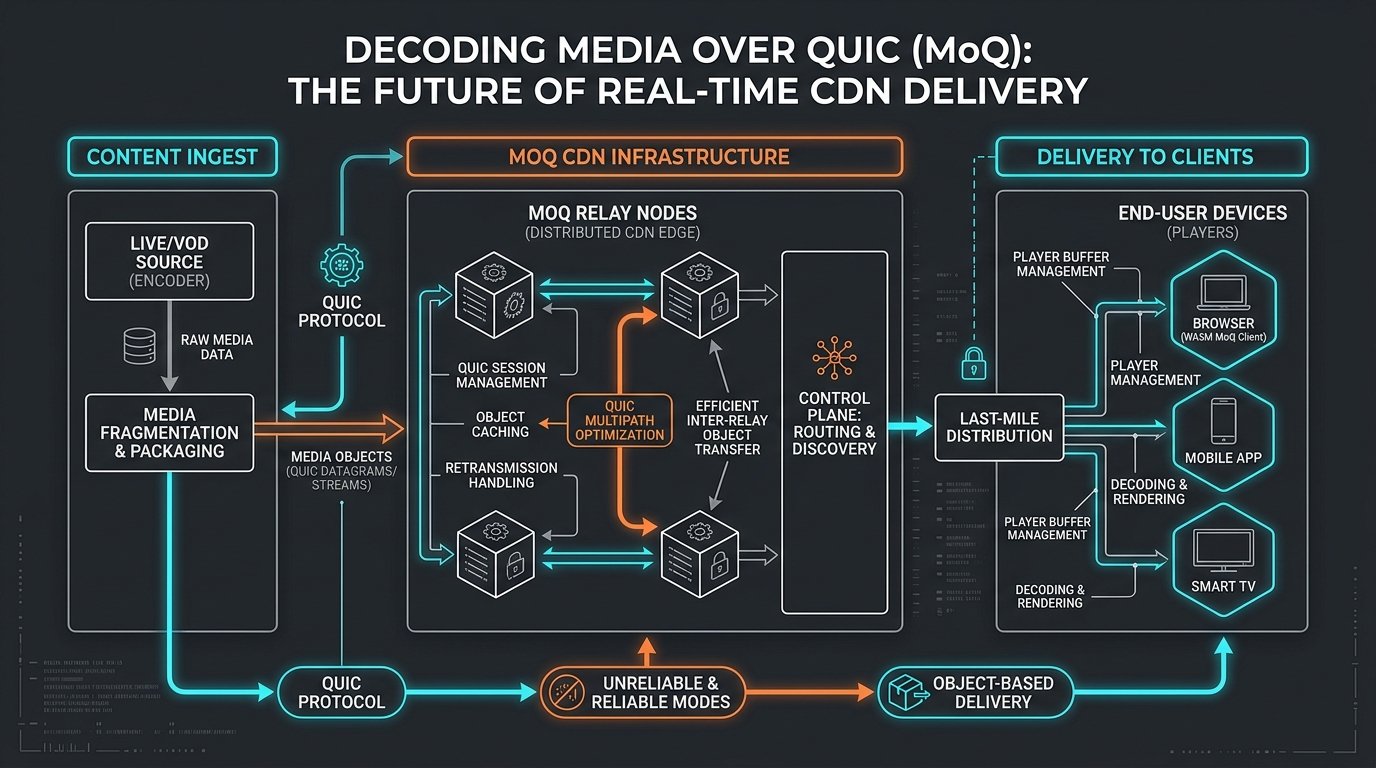
For CTOs and video platform architects, deploying MoQ means achieving WebRTC-like real-time interactions with the cost-effective scalability profile of traditional CDNs. Since QUIC runs over UDP, it avoids the heavy handshake overhead of TCP. Moreover, its connection migration capability ensures that mobile viewers experience seamless handoffs between cellular networks and Wi-Fi without stream interruptions. As the IETF standardizes the MoQ framework, early adoption at the edge is no longer just an experiment, but a strategic imperative for high-concurrency, real-time video applications.