
Decoupling Signal Transport: The Architecture of MoQ-as-a-Service (MaaS)
The evolution of video architecture is mirroring cloud computing's shift from monolithic infrastructure to serverless paradigms. Just as Software-as-a-Service (SaaS) eliminated local compute management, Media over QUIC as a Service (MaaS) abstracts complex sub-200ms transport topologies into a programmable, API-driven edge fabric. Traditional real-time streaming forced video architects into a trade-off: scale-friendly but high-latency HTTP-based delivery (HLS/DASH) or low-latency but infrastructure-heavy WebRTC meshes requiring complex SFU/MCU management and TURN/STUN orchestration.
MaaS redefines media distribution by decoupling signal ingress, edge state management, and egress routing from the origin infrastructure. Built on top of the IETF Media over QUIC (MoQ) Transport specification, MaaS exposes a publisher/subscriber abstraction layer over QUIC streams and datagrams.
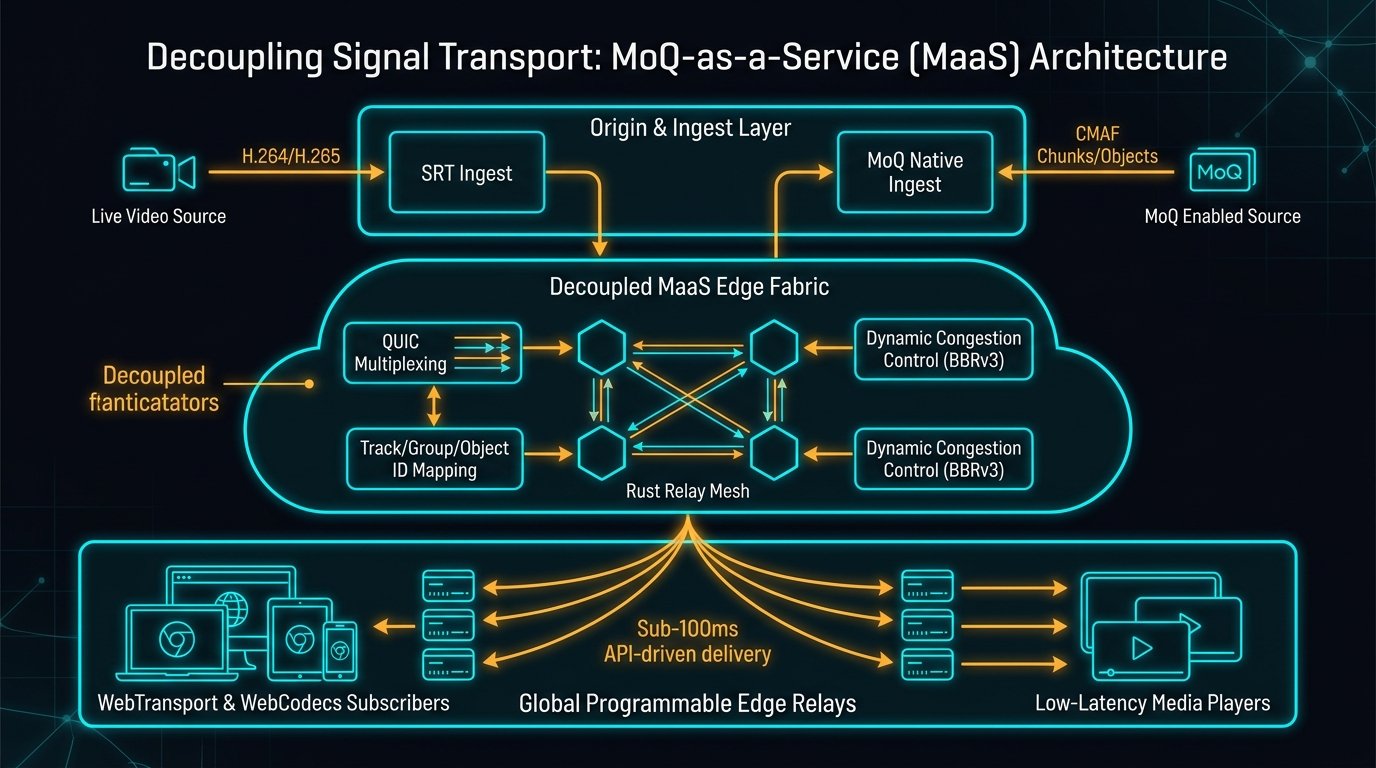
Under the hood, TereMoq’s MaaS architecture leverages a Rust-based edge relay network that handles QUIC connection migration, dynamic connection multiplexing, and localized congestion control (automating transitions between BBRv3 and CUBIC based on real-time telemetry).
By representing live media as discrete, track-based objects (Track Alias, Group, and Object IDs), MaaS enables fine-grained relay routing. Video pipelines ingest a single contribution feed via SRT or MoQ-Native Ingest. The MaaS platform then dynamically distributes object-level subscriptions across distributed Rust edge workers without requiring developers to manage stream state, session negotiation, or socket-level buffer allocations.
For principal video engineers, MaaS translates the operational benefits of SaaS—elastic scaling, SLA guarantees, zero infrastructure maintenance—to glass-to-glass media distribution, enforcing deterministic sub-100ms latency across global networks.