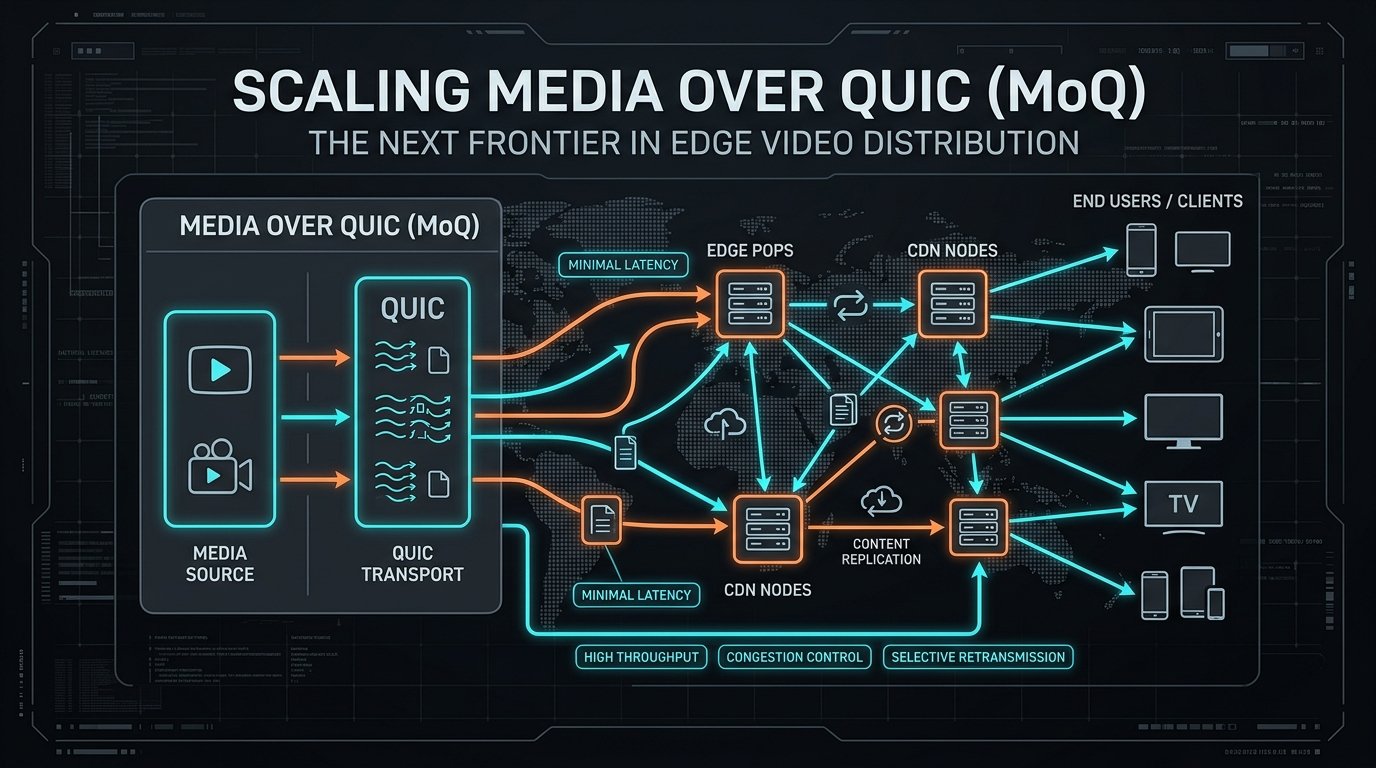
Scaling Media over QUIC (MoQ): The Next Frontier in Edge Video Distribution
As modern video workflows push past the boundaries of traditional HTTP-based streaming, legacy protocols like HLS and DASH fail to deliver sub-second latency at scale. WebRTC, while fast, introduces immense state synchronization and CPU overhead on edge nodes, making it cost-prohibitive for massive concurrent audiences. This is where Media over QUIC (MoQ) emerges as a transformative paradigm. By combining the low-latency transport properties of QUIC with hierarchical, cache-friendly publish/subscribe architectures, MoQ successfully bridges the gap between ultra-low latency and hyper-scale distribution.
QUIC’s native support for stream multiplexing, connection migration, and custom congestion control allows MoQ to treat media packets as independent objects with varying priorities. Edge servers no longer need to maintain complex WebRTC peer connections; instead, they act as simple, stateless relays. These relays can cache individual video frames or chunks as object-like resources, routing them dynamically based on subscription requests.
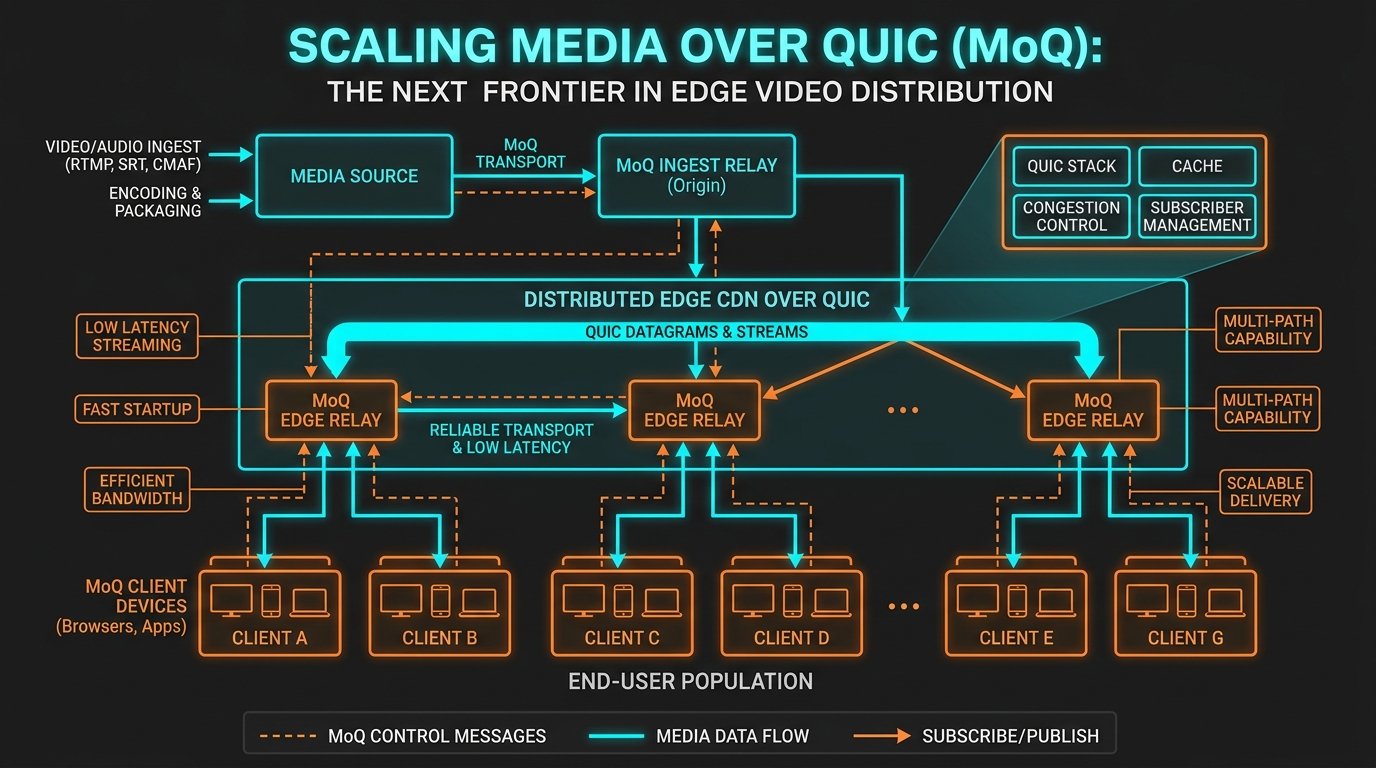
For video architects, this decoupling of transport from media delivery is crucial. Real-time streams can be published once to an ingest point and fan out across a decentralized edge network using unified QUIC datagrams or streams. Because MoQ operates natively over QUIC, it inherently bypasses head-of-line blocking while maintaining standard TLS 1.3 encryption.
Transitioning to MoQ requires a shift in how we think about CDN caching. Instead of polling manifests, the edge actively pushes media segments to subscribers using subscription-based signaling. As IETF standardization matures, early adopters deploying MoQ at the edge are achieving sub-200ms end-to-end latencies at a fraction of the infrastructure cost associated with WebRTC.