Architecting Ingest: SRT, WebRTC, and MoQ in Modern Video Pipelines
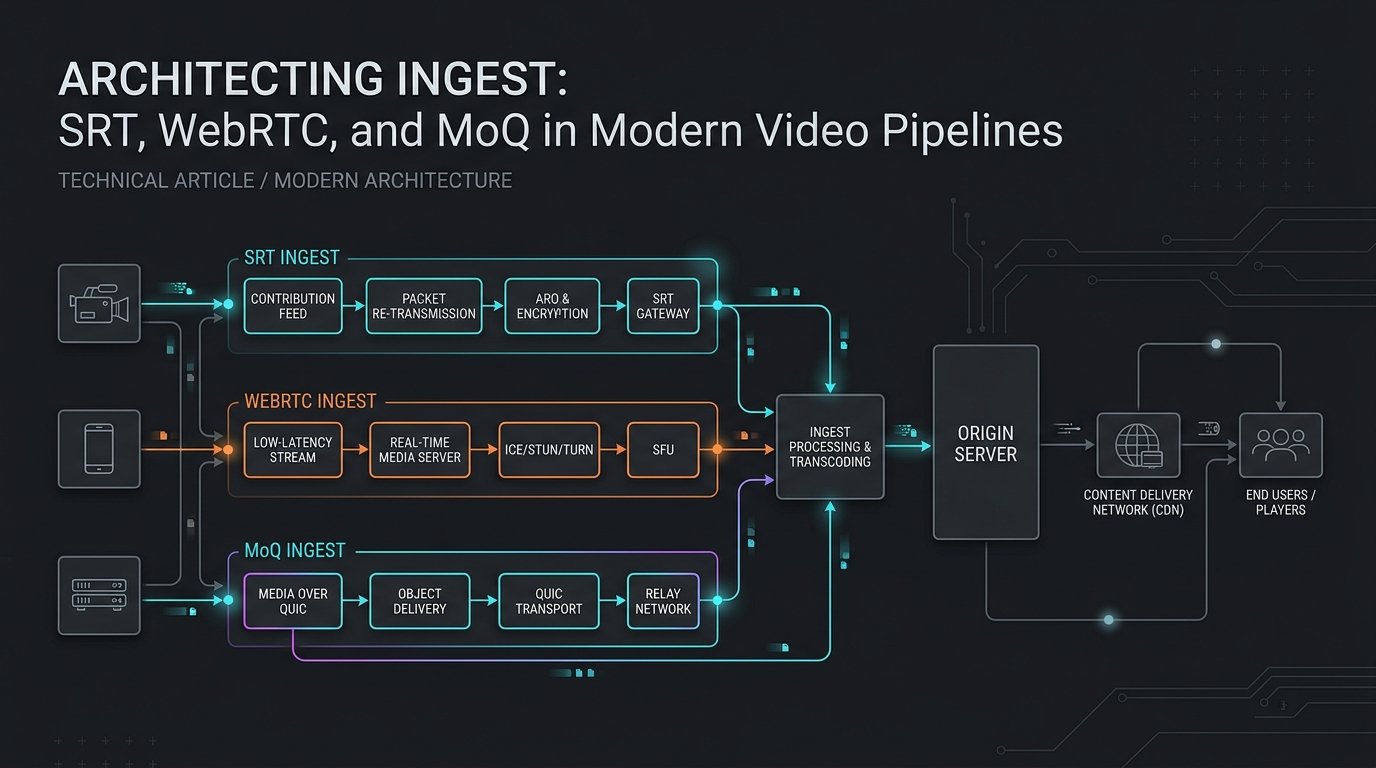
Choosing the right ingest protocol is a critical architectural decision that dictates the reliability, latency, and complexity of your entire video pipeline. For years, Secure Reliable Transport (SRT) has been the gold standard for contribution, offering robust ARQ (Automatic Repeat reQuest) error recovery over unpredictable networks. However, as interactive applications demand bidirectional communication and sub-second glass-to-glass latency, alternatives like WebRTC and the emerging Media over QUIC (MoQ) are challenging the status quo.
SRT excels in point-to-point contribution over high-loss WANs due to its configurable latency buffers and packet recovery mechanisms. However, it lacks native support for browser-based playback, requiring transcoders to repackage the stream. WebRTC WHIP (WebRTC HTTP Ingestion Protocol) solves the browser compatibility issue, providing ultra-low latency directly from a web page. Yet, it suffers from heavy UDP packet overhead, complex ICE/STUN/TURN signaling, and struggles with high-bitrate multi-track streaming.
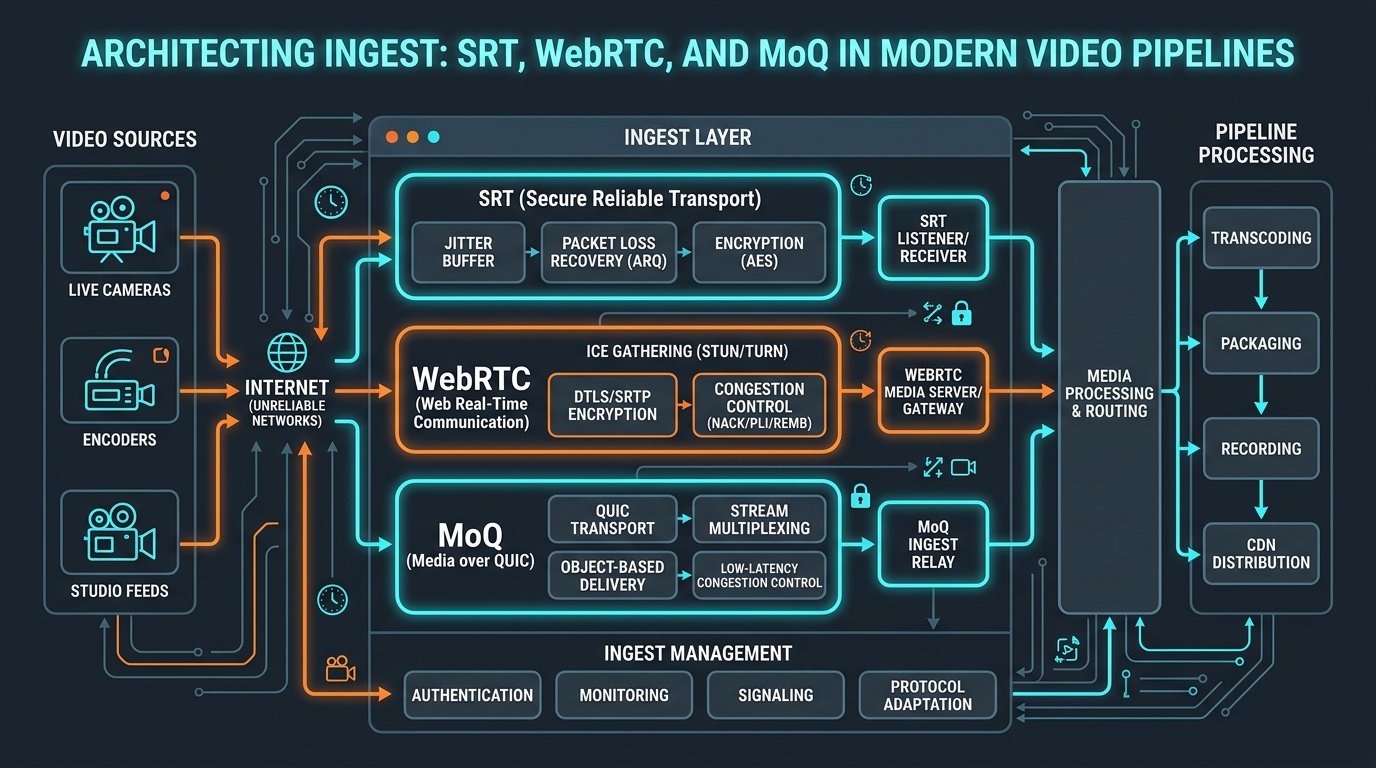
This is where MoQ introduces a paradigm shift. Leveraging QUIC as its underlying transport, MoQ offers the reliability and congestion control of SRT alongside the ultra-low latency characteristics of WebRTC. Unlike WebRTC, MoQ avoids complex peer connection negotiations, utilizing a lightweight publish/subscribe model that fits cleanly into existing edge CDN topologies.
For CTOs building next-generation interactive architectures, the decision hinges on your endpoints. If browser-based contribution with zero plugins is paramount, WHIP remains the pragmatic choice today. For high-fidelity broadcast contribution, SRT is still king. However, for organizations planning future-proof, unified pipelines that span ingest to edge distribution, MoQ represents the ultimate convergence protocol.